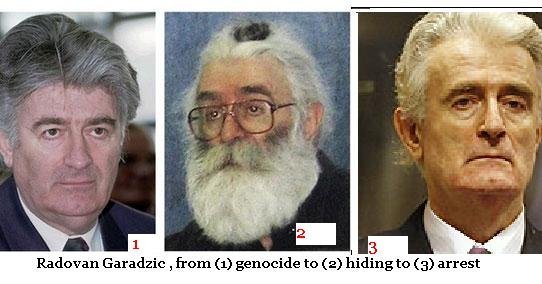
With Karadzic’s arrest, Serbia is fully prepared to apply for the EU membership, but still awaits UN chief prosecutor’s assessment in December, which would play a major role in whether members states would accept Serbia’s EU application since two other Serbian war criminals – Mladic and Hadzic – still remain at large.
The war crimes trial of Radovan Karadzic, one of the highest ranking officials indicted by the International Criminal Tribunal for the former Yugoslavia (ICTY) has begun late October, more than one year after his arrest.
Karadzic is charged with 11 counts of genocide, war crimes and crimes against humanity committed against Bosnian Muslim, Bosnian Croats and other non-Serb civilians during the 1992-95 conflict in Bosnia-Herzegovina in which some 100,000 people died and 2.2 million were forced to flee their homes.
Only quick, efficient, transparent and equitable trial against Karadzic can result in long awaited and much needed process of dealing with the past in the whole region.
Karadzic who decided to represent himself, refused to plead to charges and added that the ICTY did not have the jurisdiction to try him, because he was offered immunity by US Diplomat Richard Holbrooke, who negotiated the end of the Bosnian War in 1995.
Furthermore, Karadzic boycotted his trial claiming that he was denied the adequate time for preparation. In its November 5th ruling the Tribunal stated that Karadzic had “substantially and persistently obstructed the proper and expeditious conduct of his trial by refusing to attend the proceedings until such time as he considers himself to be ready despite this Chamber’s decision, upheld by the Appeals Chamber, that he has had sufficient time to prepare.” As a response, the Trial Chamber ordered the registrar of the Tribunal to appoint an attorney who would represent the interests of the indictee if he continues to refuse to appear in the court. The trial will resume in March 2010.
The trial is expected to last up to three years. However, only quick, efficient, transparent and equitable trial against Karadzic can result in long awaited and much needed process of dealing with the past in the whole region. But what is even more important for each victim as well as for the families of the deceased victims is the establishment of the truth.
In addition, Bosnian Muslims and Croats are waiting to see whether the trial against [?Radovan Karadzic} would prove that Milosevic and Serbia took part in the ethnic cleansing, as Karadzic seems to be the crucial figure for understanding of the relations in Bosnia and Herzegovina in that period. The discovery of new evidence may lead Bosnian legal experts to request a review of the International Court of Justice (ICJ) ruling that cleared Serbia of responsibility for the genocide of Bosniaks and Croats in Bosnia and Herzegovina and it may help Croatia’s genocide case against Serbia.
Karadzic Capture lifted Serbia EU Dreams
The full cooperation with the ICTY has been a prerequisite for all the countries in the region, including Serbia, for European integration. Karadzic’s arrest voiced belief that the arrest would convince the EU was fulfilling its obligations and that it would facilitate a rapprochement between the EU and Serbia.
In its most recent progress report, the European Commission said that Serbia’s cooperation with the ICTY has further improved, but that the ICTY indictees Mladic and Hadzic still remain at large. In the meantime, Serbia has announced that it would likely submit its EU application by the end of the year. But first, they must wait the UN chief prosecutor’s assessment, due in December, which would review the governments efforts in catching the indictees and it would play a major role in whether the EU member states would accept Serbia’s EU application.
Many experts have urged the EU to put more pressure on the countries in the region in order to establish and implement a clear strategy that will under no circumstances tolerate the impunity for war crimes, crimes against humanity and genocide no matter who has committed these crimes. The EU has responsibility within the accession process to demand from those countries to make the prosecution of war crimes, crimes against humanity and genocide a priority.


1. On 10 December 2009 at 06:03, by jill starr Replying to: The Karadzic Trial in front of the ICTY and its Influence on Serbia’s EU Bid
Irrefutable Proof ICTY Is Corrupt Court/Irrefutable Proof the Hague Court Cannot Legitimately Prosecute Karadzic Case posted Oct 5, 2009 10:02 AM by Jill Starr [ updated Nov 17, 2009 10:26 PM ]
Irrefutable Proof ICTY Is Corrupt Court/Irrefutable Proof the Hague Court Cannot Legitimately Prosecute Karadzic Case
http://lpcyu.instablogs.com/entry/nato-says-the-hague-tribunal-or-icty-belongs-to-nato- truth-bites-for-te-hague-lately/
http://picasaweb.google.com/lpcyusa/ViewMyHagueInternationalCriminalCourtPreparat
oryDocumentsFromThe2001UnitedNations# (The Documentary Secret United Nations ICC Meeting Papers Scanned Images)
This legal technicality indicates the Hague must dismiss charges against Dr karadzic and others awaiting trials in the Hague jail; like it or not.
Unfortunately for the Signatures Of the Rome Statute United Nations member states instituting the ICC & ICTY housed at the Hague, insofar as the, Radovan Karadzic, as with the other Hague cases awaiting trial there, I personally witnessed these United Nations member states openly speaking about trading judicial appointments and verdicts for financial funding when I attended the 2001 ICC Preparatory Meetings at the UN in Manhattan making the iCTY and ICC morally incapable trying Radovan Karazdic and others.
I witnessed with my own eyes and ears when attending the 2001 Preparatory Meetings to establish an newly emergent International Criminal Court, the exact caliber of criminal corruption running so very deeply at the Hague, that it was a perfectly viable topic of legitimate conversation in those meetings I attended to debate trading verdicts AND judicial appointments, for monetary funding.
Jilly wrote:*The rep from Spain became distraught and when her country’s proposal was not taken to well by the chair of the meeting , then Spain argued in a particularly loud and noticably strongly vocal manner, “Spain (my country) strongly believes if we contribute most financial support to the Hague’s highest court, that ought to give us and other countries feeding it financially MORE direct power over its decisions.”
((((((((((((((((((((((((( ((((((((((((((((((((((((( Instead of censoring the country representative from Spain for even bringing up this unjust, illegal and unfair judicial idea of bribery for international judicial verdicts and judicial appointments, all country representatives present in the meeting that day all treated the Spain proposition as a ”totally legitimate topic” discussed and debated it between each other for some time. I was quite shocked! The idea was “let’s discuss it.” “It’s a great topic to discuss.”
Some countries agreed with Spain’s propositions while others did not. The point here is, bribery for judicial verdicts and judicial appointments was treated as a totally legitimate topic instead of an illegitimate toic which it is in the meeting that I attended in 2001 that day to establish the ground work for a newly emergent international criminal court.))))))))))))))))))))))))))))
In particular., since “Spain” was so overtly unafraid in bringing up this topic of trading financial funding the ICC for influence over its future judicial appointments and verdicts in front of every other UN member state present that day at the UN, “Spain” must have already known by previous experience the topic of bribery was “socially acceptable” for conversation that day. They must have previously spoke about bribing the ICTY and ICC before in meetings; this is my take an international sociological honor student.
SPAIN’s diplomatic gesture of international justice insofar as, Serbia, in all of this is, disgusting morally!
SPAIN HAS TAUGHT THE WORLD THE TRUE DEFINITION OF AN “INTERNATIONAL CRIMINAL COURT.”
I remind everyone, when I attended those ICC Preparatory Meetings in 2001, witnessing first hand the country plenipotentiary representatives present with me discussing so openly, trading judicial funding of a new international criminal court, for its direct judicial appointments and judicial verdicts, those same state powers were
concurrently,
those same countries and people were already simultaneously, funding the already established ICTY which was issuing at that time, arrest warrants for Bosnian Serbs under false primary diplomatic pretenses.
The ICTY and ICC is just where it should be for once. Cornered and backed into and an international wall, scared like a corned animal (and I bet it reacts in the same way a rabid cornered animal does too in such circumstances). (ICTY associates)
http://picasaweb.google.com/lpcyusa/ViewMyHagueInternationalCriminalCourtPreparat
oryDocumentsFromThe2001UnitedNations# (Evidence Agaisnt the ICTY)
http://picasaweb.google.com/lpcyusa/DuringTheTrialOfRamushHaradinajIn2006TheHag
ueWarCrimesTribunalForTheFormerYugoslavi# (Documents: Hague war crimes tribunal for the former Yugoslavia (ICTY) has destroyed
all material evidence about the monsterous KLA Albanian/KLA organ trade in Kosovo)
I believe strongly that ICYU assocaites murdered former Serb President, Slobodan
Milosevic, tried to murder me, as well and other Serbs prisoners and presently places , Doctor Radovan Karadzic’s life in direct danger as well as Ratko Mladic’s life in danger should he be brought there.
The ICTY has no other choice than to halt all further court proceedings against, Doctor Radovan Karadzic, and others there both serving sentences and awaiting trials. Miss JIll Louise Starr (The UN Security Council has no choice but to act on this now).
I accuse the Hague ICTY war crimes tribunal of attempted assassination on my life and
others, contempt of court and obstruction of international justice and "international
witness tampering" in complicity with Richard Holbrook and Bill Clinton (Former US
President of the USA) as well as political playersin Spain and the Netherlands .
I represented the state interests’ of the Former Yugoslavia, in Darko Trifunovic’s absence in those meetings and I am proud to undertake this effort on Serbia’s behalf.
================================================================================== United States :
We’ve all become closely acquainted with the concepts of impunity, international law, social justice, and both licit and illicit equity within the framework of judiciary constructs.
And as such, I’ve been sitting all alone here in my room for seemingly endless years, merely contemplating these and other questions crucially important to the conceptual role of international criminal justice:
1) Many news media presenters argue certain leaders of political parties and organized crime syndications are “arrogant,” for believing they themselves are above the rule of law.
However, the award for winning the Olympic Gold Metal of being ‘Mother of All Arrogance’ has just be captured by Hague’s Highest Legal Entity, the newly constructed International Criminal Court.
2) This entity shamelessly and explicity proclaims its own impunity from international justice while increasing its push moving forward in prosecuting others for identical crimes itself commits. It flaunts its diplomatic immunity as if it were the President of the most powerful country on earth. Claiming to rival the powers of the Queen of England and the Holy See.
Attachments (15)
* icc1.jpg - on Oct 31, 2009 7:27 PM by Jill Starr (version 1) Remove 126k View Download * icc2.jpg - on Oct 31, 2009 7:27 PM by Jill Starr (version 1) Remove 169k View Download * icc3.jpg - on Oct 31, 2009 7:28 PM by Jill Starr (version 1) Remove 133k View Download * icc4.jpg - on Oct 31, 2009 7:28 PM by Jill Starr (version 1) Remove 159k View Download * icc5.jpg - on Oct 31, 2009 7:28 PM by Jill Starr (version 1) Remove 172k View Download * icc6.jpg - on Oct 31, 2009 7:28 PM by Jill Starr (version 1) Remove 168k View Download * icc7.jpg - on Oct 31, 2009 7:28 PM by Jill Starr (version 1) Remove 172k View Download * icc88.jpg - on Oct 31, 2009 7:28 PM by Jill Starr (version 1) Remove 157k View Download * icc9.jpg - on Oct 31, 2009 7:29 PM by Jill Starr (version 1) Remove 158k View Download * iccanada1.jpg - on Oct 31, 2009 7:29 PM by Jill Starr (version 1) Remove 110k View Download * iccanada2.jpg - on Oct 31, 2009 7:29 PM by Jill Starr (version 1) Remove 149k View Download * iccanada3.jpg - on Oct 31, 2009 7:29 PM by Jill Starr (version 1) Remove 179k View Download * icclast1.jpg - on Oct 31, 2009 7:29 PM by Jill Starr (version 1) Remove 75k View Download * iccolumbia1.jpg - on Oct 31, 2009 7:29 PM by Jill Starr (version 1) Remove 167k View Download * iccolumbia2.jpg - on Oct 31, 2009 7:30 PM by Jill Starr (version 1) Remove 198k View Download
Attach a file: Comments (0)
Follow the comments: |
|
